Rameau published Le Rappel des oiseaux in 1724, among his harpsichord pieces, and its reputation has always rested on the birds. Le Ménestrel’s 1864 survey of the clavecinistes counted it among Rameau’s “de petits portraits, de petits poèmes, de petits tableaux pleins de vérité, et dans lesquels la mélodie parle, décrit, imite” (“little portraits, little poems, little pictures full of truth, in which the melody speaks, describes, imitates”). When the Société des instruments anciens played it in 1895, the same journal’s critic found it “absolument exquise” (“absolutely exquisite”) and reported an encore. J. A. Fuller Maitland, writing in 1902, judged that Rameau’s harpsichord books “contain things that rival Couperin himself.”
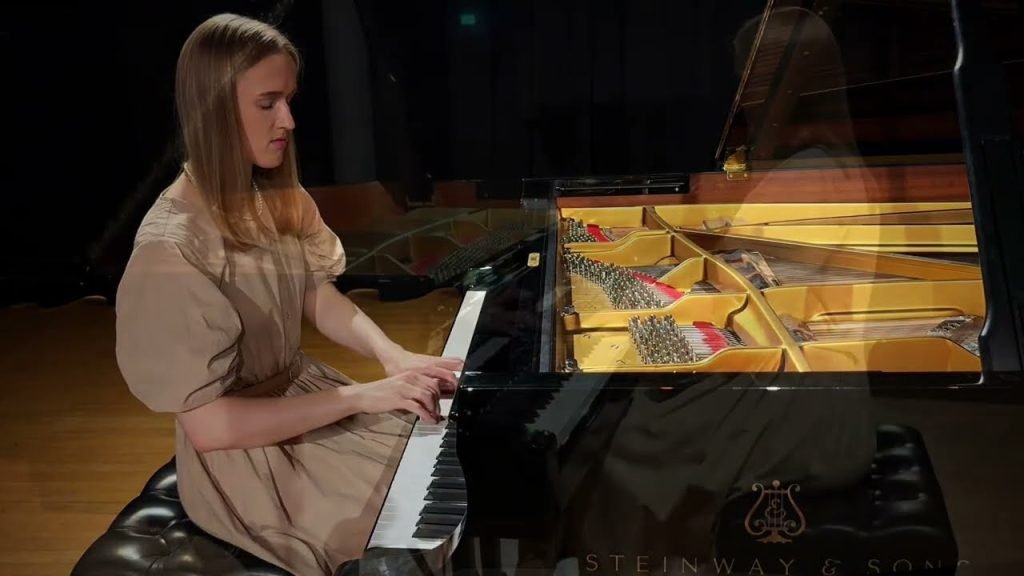
Vasylyna Hrynevych, credited in the video title and channel name, plays it on a Steinway grand with the lid fully open, against black drapes on a wooden stage floor. The filming is unfussy: slow cross-fades between three angles (side, behind and a close-up of the keyboard), no hard cuts, and one figure at the keyboard throughout.
Her tempo is deliberate and unusually even. On a modern grand the piece loses the harpsichord’s quick decay, and she answers with a dry, clipped articulation that keeps the calls from blurring into one another. Both halves are played with their repeats, and the pulse barely moves across the four passes; the second half, which opens in G major, sits only fractionally broader than the first. That steadiness makes the calls sound like patterning rather than surprise, with the chirping repeated notes evenly spaced and the ornaments folded neatly into the beat.
Dynamics follow the harmony rather than the birds. Around (1:40), deep in the second half, she drops to some of the softest playing of the performance, then builds to the strongest bars just before the cadence; the repeat goes quieter still before the same climb. She marks that cadence with the same small broadening each time, at (2:11) and again in the repeat. At moments her left hand floats well clear of the keys while the right carries on, a small gesture of the lightness this music needs.
Sam Johnstone heard Víkingur Ólafsson’s encore in Berlin in 2017 as one in which “its evocative birdcalls were vibrant and joyful.” Hrynevych is cooler and more architectural, closer to a careful transcription of birdsong than a dawn chorus, and she plays the repeats as near mirror images rather than new conversations. Listeners who want Rameau’s wit may miss a little daring; those who want his order will find it beautifully kept.