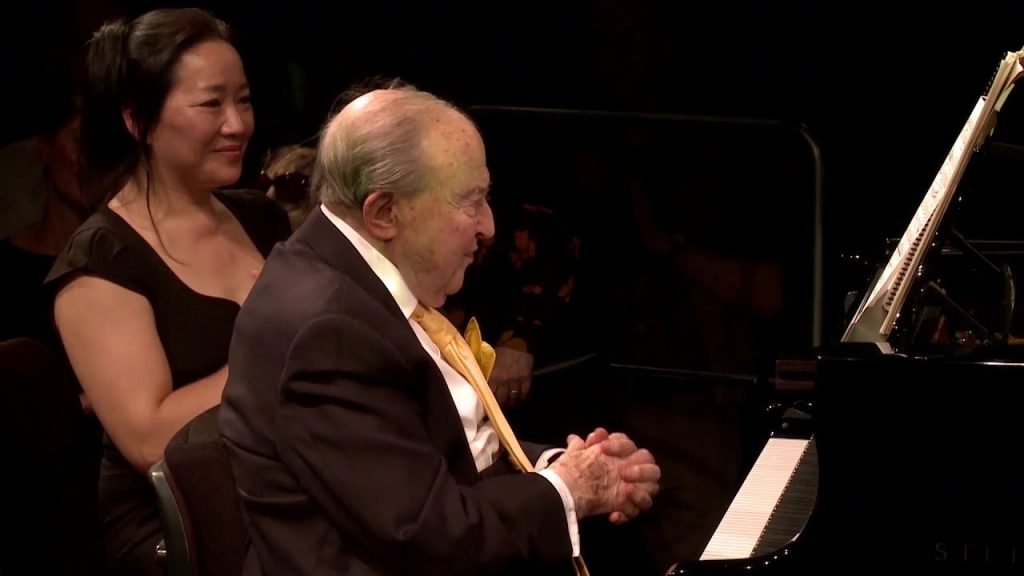
Chopin wrote this little Lento con gran espressione in Vienna in 1830, at twenty, for his sister Ludwika to practise before she tackled his F minor Concerto. He filled it with private memories: snatches of that concerto and of his song “Życzenie” (“The Maiden’s Wish”), the sounds of a homesick young man on the eve of exile. It was not published until 1875, long after his death. To hear it played by a pianist of 94, in a darkened Berlin club with the audience almost at his feet, closes a circle: a young man’s farewell, read by an old man’s hands.
The opening chords are slow and weighty, and when the melody enters it sings with a fragile, bell-like warmth. A light pedal keeps the harmonies glowing without blur. Henry T. Finck called the pedal “the supreme test” of a Chopin player, and Pressler passes it with ease. Finck also argued that the nocturnes should be played slower than most pianists dare, and Pressler takes him at his word. His rubato is extreme. Phrases stretch until time seems almost to stop, the pulse drifting and holding back throughout. It recalls Liszt’s description of Chopin’s own rubato, “vacillating as the flame under the fluctuating breath”. Purists may remember Chopin’s advice to his pupils that the left hand “should be like a bandmaster, and never for a moment become unsteady”. Here the bandmaster sometimes wanders, and the whole beat flexes with the melody.
There are signs of age. Around 1:29 the left hand hesitates briefly, a slip Pressler absorbs by leaning further into the rubato. A few inner notes smudge later on, and the balance wavers in thicker textures. The ornaments are sung rather than flashed. The middle section, with its concerto and song memories, has an affectionate, conversational lilt, and the closing runs come out as shimmering murmurs rather than bravura. The last C-sharp major chord (about 4:16) fades into a silence the room is reluctant to break.
The editors of The Art of Music warned critics against “the halo of old age”, the urge to overvalue an artist’s late work out of reverence. That caution applies here: as a display of finger perfection this falls short of Pressler’s prime. But the tenderness is in the playing itself, not in the legend around it.