Eight bars of fingering practice can be heard as music rather than homework, and Bach seems to have thought so. The Applicatio stands in the little clavier book of 1720 for his son Wilhelm Friedemann, then nine years old, and C. F. Abdy Williams, in his 1900 study of Bach, noted that “one of the pieces is figured”, that is, marked with fingerings, and headed Applicatio, in nomine Jesu: fingering, in the name of Jesus. Arnold Dolmetsch, examining Bach’s own fingerings in 1915, said of this piece and its companions: “They are all very fully fingered.” The point was the hand. As the first volume of The Art of Music (1915) put it, describing keyboard playing before Couperin, “The thumb hung idle.”
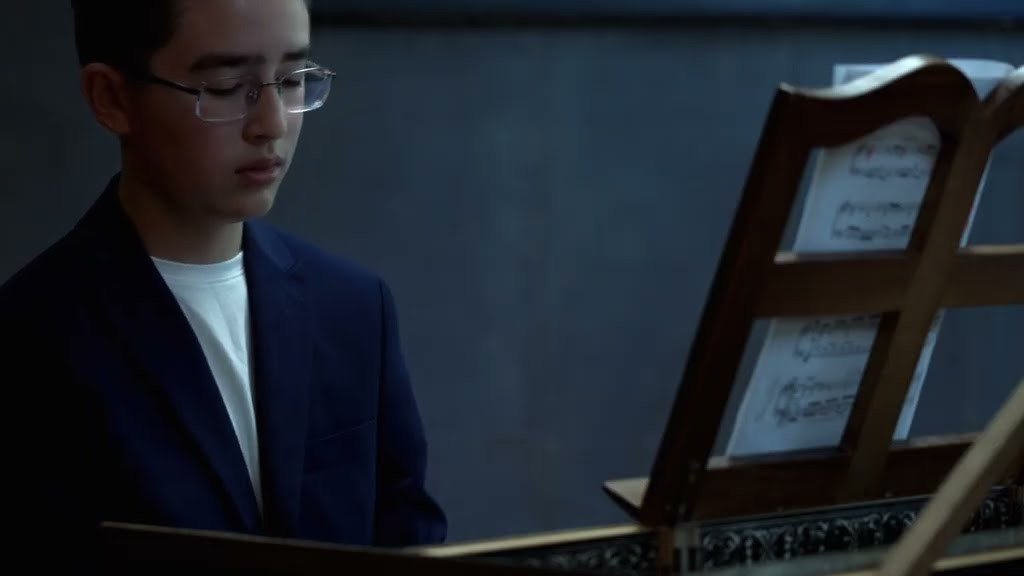
Fernando Lourens, one of seven young keyboard players in the Society’s masterclass project, takes the lesson at its word. His tempo is unhurried and almost unwaveringly steady, so the rising scale of the opening bar, with its mordents, sounds like a hand finding its place rather than a showpiece. Both halves are repeated, and the repeat of the first half is close to a carbon copy of its first pass, with the same pacing and the same breathing points. The second half, which carries the longer trills, arrives at (0:38) and takes a little more time than the first. The bar of repeated Cs over a left hand walking downwards is kept beautifully even, and he broadens only slightly into the final cadence (1:10).
The instrument is a two-manual copy of a Ruckers, tuned to the low Baroque pitch that the Society confirms in a reply beneath the video, and it gives each mordent a clean, silvery bite without any hardness in the bass. The film cuts between a wide view of a room with tall windows, close views from the side, and an overhead shot during the second half that shows both hands working on the lower of the two manuals, with a single sheet of music on the desk.
Listeners who want a sense of play may find the strict mirroring of the first-half repeat a touch earnest; a little more freedom on the second pass would not have betrayed the lesson. Lindsay Kemp, reviewing Mahan Esfahani’s Hyperion collection of Bach’s preludes, inventions and sinfonias for Gramophone, called such pieces “full-on Bach, pure and lovable”. Lourens is less lovable than lucid, but lucidity is what this lesson asks for, and he delivers it cleanly.