Whether this prelude truly remembers rain is older than any single performance. The Musical Times in 1923 shrugged the nicknames away: “Whether Chopin himself thought of rain or clocks doesn’t much matter.” What matters is the form. In The Art of Music, Volume II (New York, 1915), edited by Leland Hall and César Saerchinger under Daniel Gregory Mason, the prelude in D flat major — “the so-called ‘raindrop’ prelude” — is one Chopin “worked out at length, with conscientious regard for form.”
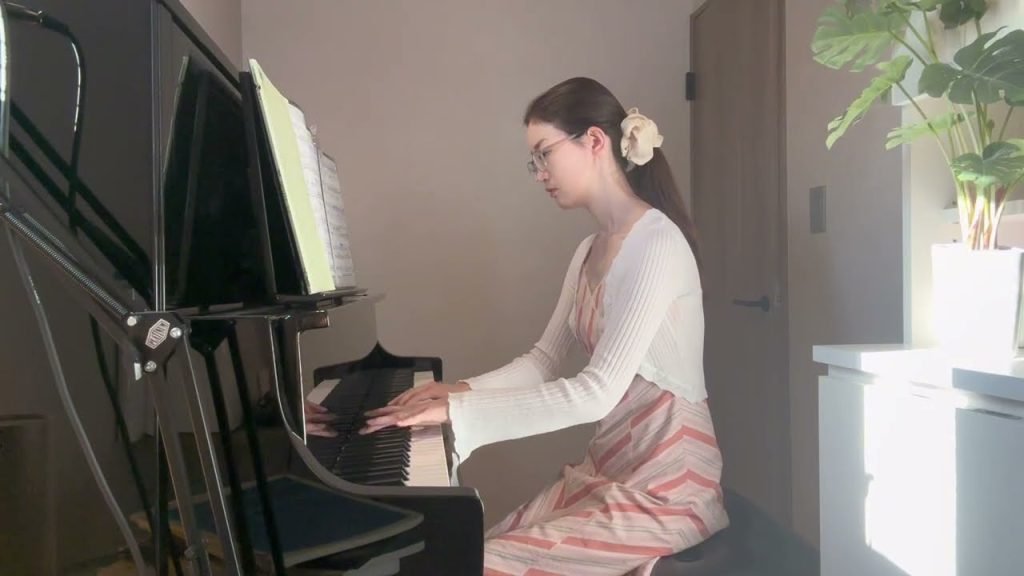
The pianist on the umino_piano channel treats that form as a single breath with a storm inside it. She plays from the score at a black grand piano, lid open, in a plain sunlit room: a closed door, a broad-leaved plant, daylight falling from the right. The sound is close and dry, without a hall’s halo. Her feet stay out of frame, but the pedalling is clean; the thickest writing never blurs.
The opening melody sings above a repeating note that stays present without tapping on the ear. Rubato comes in gentle breaths at phrase ends. The darker middle music (1:28) drops the tune into the left hand and lets the repeated note keep watch above it. When the first climax arrives (2:03), she uses weight rather than force; the tone stays full, not hard. Then, with a sudden hush (3:48), the first music returns as if the weather had passed in the next room. The coda leaves the repeated note almost alone before the last cadence settles into silence.
A Musical Times review of Pachmann’s 1925 recording praised how “the climax of the second subject is magnificently dealt with, contrasting finely with the placidity of the opening phrases.” That contrast is the piece’s secret, and she finds it without storm-acting. The channel dates the playing to 6 June 2026. If one still hears rain, it falls in a room someone lives in.