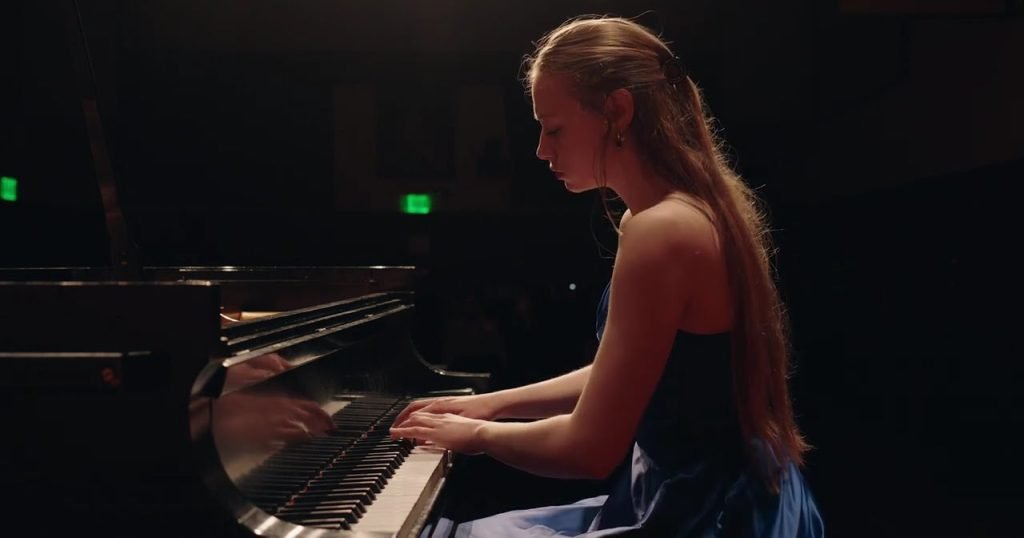
Alexandra Burch is a talent to be experienced rather than merely heard, and her account of Scarlatti’s Sonata in B minor, K. 87, makes that plain within its opening bars. This is an inward, singing sonata in which several voices move together and gently overlap, and she plays it with the calm assurance of a pianist who trusts the music to speak for itself.
Her touch is what captivates first. Her beautiful, delicate fingers seem to dance across the keys rather than press them, so that every line sings with a soft, rounded glow. On the opening page, where Scarlatti holds notes over the bar line so that one voice leans tenderly against the next, she lets each of those small tensions ache and then melt, never hurrying the release. The pulse stays unhurried and even, yet nothing sounds mechanical; she eases into the first phrase as naturally as a singer drawing breath.
J. A. Fuller Maitland, in The Oxford History of Music (1902), wrote of “the quaintly artificial melancholy of a few” of these sonatas. There is nothing artificial about her melancholy. When the first half comes to rest on its hushed, open-ended chord, she lingers just long enough for the silence to carry meaning, and the second half (1:12) begins as if continuing a thought rather than starting anew.
Charles Burney reported Scarlatti’s own reasoning: “as Nature had given him [Scarlatti] ten fingers, and, as his instrument had employment for them all, he saw no reason why he should not use them.” Alexandra Burch gives all ten their employment with remarkable grace. In the second half, as the flowing runs in the upper voice grow fuller, she lets the sound bloom warmly, reaching its richest glow around (1:57), and then draws it back with exquisite care, so that the closing pages fade softly towards the final deep bass note, a true and quiet farewell. The inner voices stay clear throughout, and the left hand supports the melody like a gentle hand on the shoulder.
The film adds to the pleasure: the warm, wood-panelled setting suits the music’s intimacy, and in the final pages the camera moves to the side of the keyboard, letting us watch her hands shape the last phrases with quiet poise.
The 1915 survey The Art of Music observed that “Many of Scarlatti’s short pieces have the warmth of genuine emotion,” and this performance makes that warmth felt in every bar. It is musical, sincere and beautifully poised. I will follow her posts closely.

It is unfortunate that a performance of this quality should have drawn only one review. Anastasiya Bazhenova’s live reading of Mendelssohn’s Song Without Words in F-sharp minor, Op. 67 No. 2, filmed at Fredrikstad Church in Norway in July 2026, is too complete, too carefully felt, to sit almost unnoticed.
The beauty of the place belongs to the first impression. The church is lit as if for listening rather than display: pale pews along a striped runner, cream walls and gold-trimmed wood, candles burning on the altar beside a vase of pink flowers, a painting of gathered figures above. A black Petrof grand stands on the wooden platform with its lid open. Bazhenova’s composure at the instrument already tells how she will play; her gaze stays lowered in concentration.
Mendelssohn, writing to Marc-André Souchay from Berlin on 15 October 1842, said of music like this: “What the music I love expresses to me, is not thought too indefinite to be put into words, but, on the contrary, too definite.” That is the right way into this F-sharp minor song from the sixth book. It does not ask for a title. It asks to be heard as the current it is: a restless run of quick notes from the first sounds, urgent and light at once, with a singing line riding the motion rather than interrupting it.
Bazhenova understands that double demand. The opening is fleet without becoming brittle; the fingers stay even, and she pedals so that the harmony can bloom without smudging the running figures. The film comes in close enough to show that control, then steps back down the aisle so that the church itself seems to hold the sound. As the piece gathers, the figuration grows more intricate and the tone takes on weight, until the music arrives at its heaviest chords (1:50). She gives those chords real conviction — a live climax, not a studio taper — yet she does not let the restlessness harden into mere nerve. Mark Pullinger, writing in Bachtrack of Simon Trpčeski at Wigmore Hall, found this same F-sharp minor song “rather too nervy, missing the last gossamer touch.” Bazhenova’s urgency is real, but the gossamer is there when it matters. After the climax the current eases into quieter, more lyrical phrasing, and the last chords fade to a lingering stillness (2:14). She leans into those final sounds and lets the silence stand for a moment before the audience answers.
Daniel Gregory Mason, in The Romantic Composers (1906), heard in the Songs Without Words “a strain of mild lyricism,” adding that Mendelssohn “is never intimate or reckless, he never wholly reveals himself.” A later age has often taken that reserved view as the last word. An unsigned notice in The Musical Times of 1 February 1927 put the better case: “Despite the supercilious attitude of many towards Mendelssohn’s ‘Songs without Words,’ the charm and finish of the best of them can still delight.” Bazhenova’s playing has the finish, and more than mild charm. She is more intimate with the line than Mason’s reserved Mendelssohn would suggest, and at the climax the tone takes on a heat that is anything but dispassionate — then she withdraws it, as the song itself does.
Harriet Smith, reviewing Javier Perianes’s Songs Without Words in Gramophone, wrote that “the second of Op 67 gains in wistfulness from the way Perianes allows the phrases to hang in the air,” while Bertrand Chamayou struck her as “altogether more pert” and Daniel Barenboim “a degree or two slower and less spontaneous-sounding.” Bazhenova, in this church, is closer to spontaneous than to slow, and closer to song than to mere pertness. The phrases do hang at the close, but they have had to travel to get there. Listeners who want only hanging air from first note to last may prefer Perianes; what this film offers is a complete live sentence, spoken in a beautiful room by a pianist who means every phrase.
The recording lets the church speak without swallowing the piano. Between the close views of her hands on the Petrof and the wide look down the aisle — congregation, candles, open lid — the film shows why the piece belongs here. It is a performance to return to, and it should not have been left with a single review.
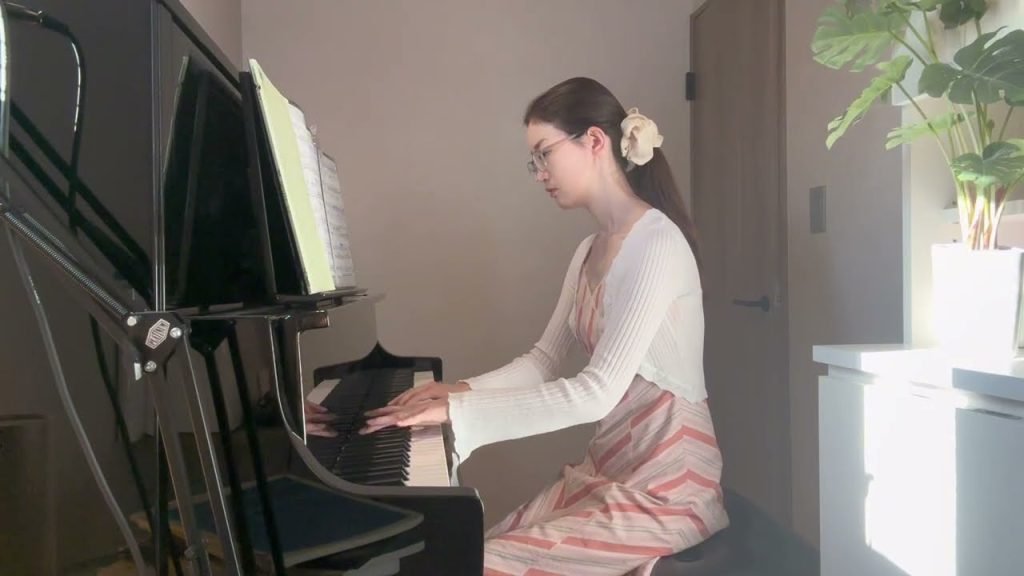
Whether this prelude truly remembers rain is older than any single performance. The Musical Times in 1923 shrugged the nicknames away: “Whether Chopin himself thought of rain or clocks doesn’t much matter.” What matters is the form. In The Art of Music, Volume II (New York, 1915), edited by Leland Hall and César Saerchinger under Daniel Gregory Mason, the prelude in D flat major — “the so-called ‘raindrop’ prelude” — is one Chopin “worked out at length, with conscientious regard for form.”
The pianist on the umino_piano channel treats that form as a single breath with a storm inside it. She plays from the score at a black grand piano, lid open, in a plain sunlit room: a closed door, a broad-leaved plant, daylight falling from the right. The sound is close and dry, without a hall’s halo. Her feet stay out of frame, but the pedalling is clean; the thickest writing never blurs.
The opening melody sings above a repeating note that stays present without tapping on the ear. Rubato comes in gentle breaths at phrase ends. The darker middle music (1:28) drops the tune into the left hand and lets the repeated note keep watch above it. When the first climax arrives (2:03), she uses weight rather than force; the tone stays full, not hard. Then, with a sudden hush (3:48), the first music returns as if the weather had passed in the next room. The coda leaves the repeated note almost alone before the last cadence settles into silence.
A Musical Times review of Pachmann’s 1925 recording praised how “the climax of the second subject is magnificently dealt with, contrasting finely with the placidity of the opening phrases.” That contrast is the piece’s secret, and she finds it without storm-acting. The channel dates the playing to 6 June 2026. If one still hears rain, it falls in a room someone lives in.

Mozart’s D minor Concerto is the one later generations heard as drama rather than porcelain. In April 1956 the Musical Courier, reviewing Myra Hess with Bruno Walter, put the matter in a sentence that still holds: “This is Mozart at his most outspokenly romantic, and the performance pulsated with the appropriate feeling without ever failing in precision and clarity.” Anastasiya Bazhenova’s live account lives in that same double demand.
The video’s opening titles name her and the work. The channel’s description places the concert with Vestfold Symfoniorkester under Lars-Erik ter Jung at Hjertnes Kulturhus, Sandefjord, on 28 February 2026 — details the pictures themselves do not spell out. What they do show is a darkened hall and a stage washed in deep blue. Bazhenova sits at a black grand whose lid has been taken off entirely. A chamber orchestra curves around her: violins to the left, lower strings to the right, winds farther back in the gloom. The conductor stands unusually behind the lidless piano, facing the players with his back to the house — a practical solution once the lid is gone, and one the camera catches when his baton dips into a close-up.
The first movement opens as a storm, tense and close. When the piano finally speaks (2:18), the mood turns solitary: a sorrowful, singing entry after all that weather. She keeps the line clear without bleaching the minor-key unrest. The orchestra stays taut around her; nothing in the first span sounds cautious, and nothing sounds forced. Later she takes a substantial cadenza, then yields the close to the orchestra. The Romanze begins in composure; its stormy middle section (17:11) darkens the room without breaking the singing tone, and the first theme’s return restores the earlier calm until the movement fades. The rondo starts at a run, fiery D minor from the keyboard, then brightens into playful major episodes. After a shorter cadenza the music turns, suddenly festive, into D major (28:22) and stays there, joyful and driving, through the last chords. Applause and cheers break in at once; she stands, and the conductor steps forward to share the bow.
Two years before the Hess notice, the same magazine had praised Guiomar Novaes with the Pro Musica Symphony of Vienna under Hans Swarowsky for “admirable instrumental support, creating an incredible texture of piano and orchestral performance.” Support is the right word here, even if the broadcast mix keeps the piano well forward — close enough that the woodwinds sometimes recede when the playing is loud. The ensemble itself does not fray. Removing the lid looks like a wish to let the band and the soloist breathe the same air; the microphones, perhaps inevitably, still favor her. What one hears is feeling that does not lose its outline: romantic Mozart, spoken plainly, with sunlight in the last pages that the hall answers in kind.
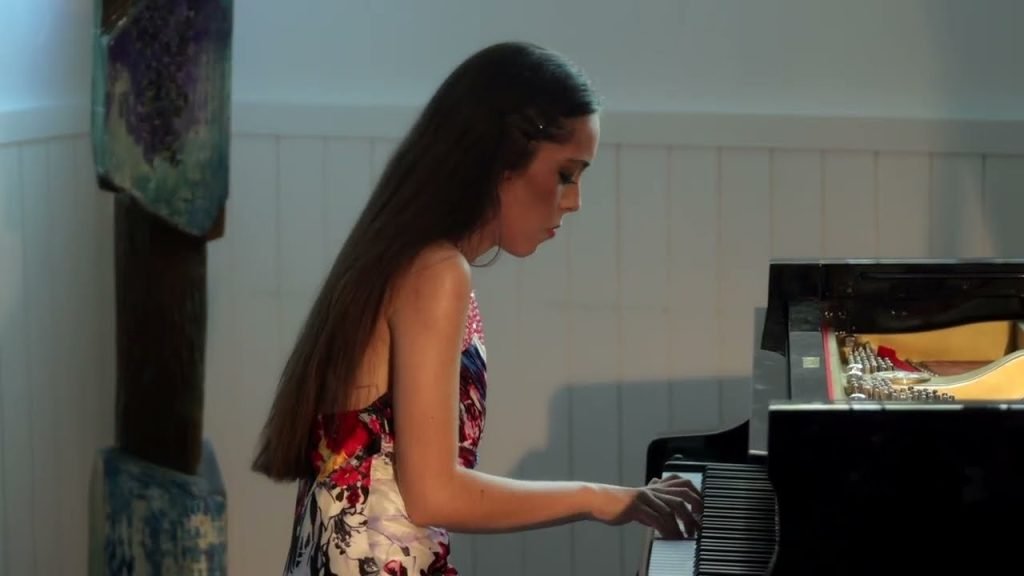
Alfred Cortot was not kind to Debussy’s first piano pieces. In The Piano Music of Claude Debussy (1922), he grouped the two Arabesques of 1888–1890 with the Ballade and their companions and judged them “but feeble in foreshowing that refined musical sense, sovereign in its power,” which the later Préludes and Images would possess. Charles W. Wilkinson, writing a few years earlier in Well-Known Piano Solos (1915), had already guessed why the first Arabesque would outlive such faint praise: it is “the favorite, being rather more sentimental,” an early work one may “take … with open arms.” Andrea Bayona’s live performance makes Wilkinson’s instinct feel just, and Cortot’s caution feel like a man listening for the wrong masterpiece.
The video itself does not name the hall, but the channel states that she recorded the piece on 1 July 2026 at Espacio Ronda in Madrid. What the camera shows is an intimate room: white panelling, a geometric stained-glass window behind a black grand piano with its lid fully open, and some twenty listeners visible from the aisle. Close shots catch supple wrists and clear finger speech; her feet stay out of frame, so the pedalling has to be judged by ear.
It is generous and atmospheric, a warm wash that never turns the harmonies to fog. The opening figuration ripples downward as if the hand were pouring water rather than striking keys. When the more singing melody arrives (1:21), she lets it stand above the rolling accompaniment instead of bathing both in the same colour. The more animated middle stretch (2:02) brings a playfully crisper touch — short chords that almost dance — before she slips back into the current. The return of the first music is softer than the opening, more inward, and the close is a long, unforced slowing toward a final chord left in the air. Then she stands and bows to applause that sounds close, as it should in a room of this size.
Roy Westbrook, writing in Bachtrack of Jean-Efflam Bavouzet’s Debussy day at Milton Court in 2018, recalled Bavouzet’s story that the first Arabesque, “of all pieces, was a particular Boulez favourite,” even as the piece “evoked the salon.” Bayona understands both halves of that remark. She does not make an early salon piece sound like a Prélude; the pulse still breathes under a free rubato, so the charm never loses its spine. A Musical Times notice of 1910 already found a young pianist’s “fluent style … well suited to Debussy’s first ‘Arabesque’”; fluency is exactly what this reading offers, but fluency in the service of a line that sings.
No slip announces itself. The room’s acoustic is clear rather than cavernous, which helps the top voice speak. What she offers is not a prophecy of the Debussy to come. It is the Arabesque as a complete pleasure: water, song, a little dance, and a vanishing.

Pergolesi’s “Fac ut portem” does not cry out. It walks. The Latin plea — make me bear Christ’s death — arrives only after the little band in this church has set a somber, even tread, two violins and cello stepping with a digital keyboard in the continuo’s place. Then the mezzo-soprano Anastasia Slipchenko enters, and the walk becomes a sentence.
She stands among the altar candles and a warmer production light, a blue folder marked PERGOLESI open in her hands. She reads from it throughout. Gothic arches, stone columns and a gilded altar give the picture its gravity; the video never names the church, and there is no need to invent one. The camera moves without fuss from the four players seated before her to the line she is spinning.
Later writers heard this scoring as close to the work’s original means. In Famous Composers and their Works, edited by John Knowles Paine, Theodore Thomas and Karl Klauser (copyright 1891), the Stabat Mater is remembered as written “for two female voices with a string-quartet accompaniment” and as a piece that “enjoyed for a while extraordinary popularity.” J. A. Fuller Maitland, in The Oxford History of Music, Volume IV (1902), is sharper about the accompaniment — “Strings and organ are the only accompaniment of the work in its original condition” — and more valuable about the vocal writing: “his vocal treatment is flowing and natural, yet he never yields to the temptation of writing for the sake of the singers, or of allowing the vocal phrases to obscure the musical idea.” Slipchenko takes that warning as a virtue. Her first phrase arrives gently after the long ritornello (0:43), picking up the melody the strings have already spoken. The grief stays inside a legato that never turns into display. The ornaments are small, a flicker of trill or an appoggiatura that leans rather than winks, and the breath is long enough to let each clause finish as a thought.
Fuller Maitland called the Stabat Mater, for “the extreme beauty of every page,” “one of the salient sacred works of all time.” Beauty here is not sweetness piled on the text. Jane Shuttleworth, reviewing a 2014 English Concert performance for Bachtrack, heard in this same alto aria “sensual words about swooning in Christ’s blood” and praised a fluid sense of line. Slipchenko finds that gravity without thinning the sorrow. After a middle ritornello the voice returns (1:49) on “Fac me plagis vulnerari,” a little more openly wounded, the line still unbroken. She tapers the last note so the instruments can take the thought from her, and they close on a held chord.
Nothing in the ensemble jolts the ear. The players share the same walking step, and the balance leaves her voice clear without turning the strings into haze. This is one number from a work written for two women, not a complete Stabat Mater. What stays is the evenness of her compassion. She does not decorate Pergolesi’s idea. She carries it.
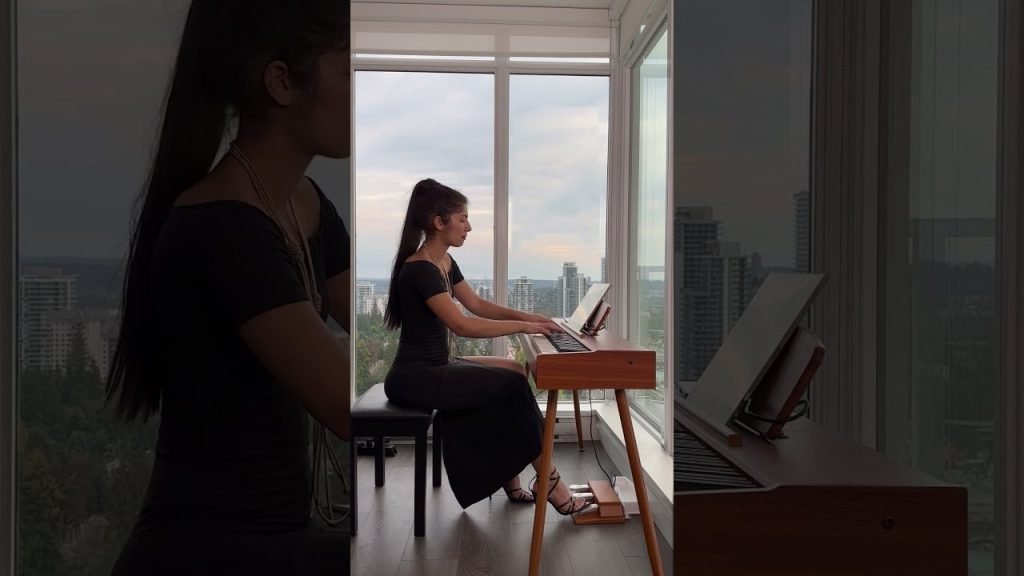
Ariana Abedini plays Lyadov’s Prelude Op. 57 No. 1 in D-flat major. The Musical Times praised Nadia Reisenberg’s “sympathetic treatment” of this very prelude and its companion, calling them pieces that “make good hearing.” Abedini begins in a hushed register, then lets the line gather toward a warm crest near the close (1:28), the D-flat harmony glowing rather than forced. Soft opening, singing middle, and a controlled final bloom: a brief prelude given the care of a song, not a sketch.
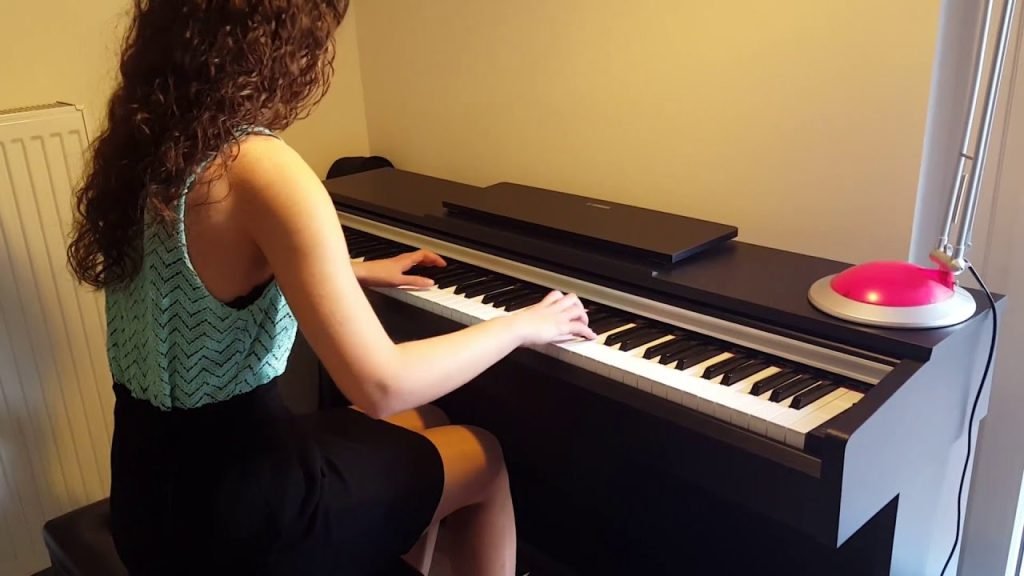
Ariana Abedini’s Rondo alla Turca, the finale of Mozart’s Sonata in A major, K. 331, gives the Janissary snap its due. Oskar Bie wrote that the Turkish March “stands out in variegated national colours, far removed from every triviality—if only we give to the Janissary rhythm its full due.” She does: the A sections land with bright, pointed articulation (1:13), the left hand’s drumming figures crisp, and the returns keep their sparkle rather than blur. It is bright, buoyant playing, stylish in sound.
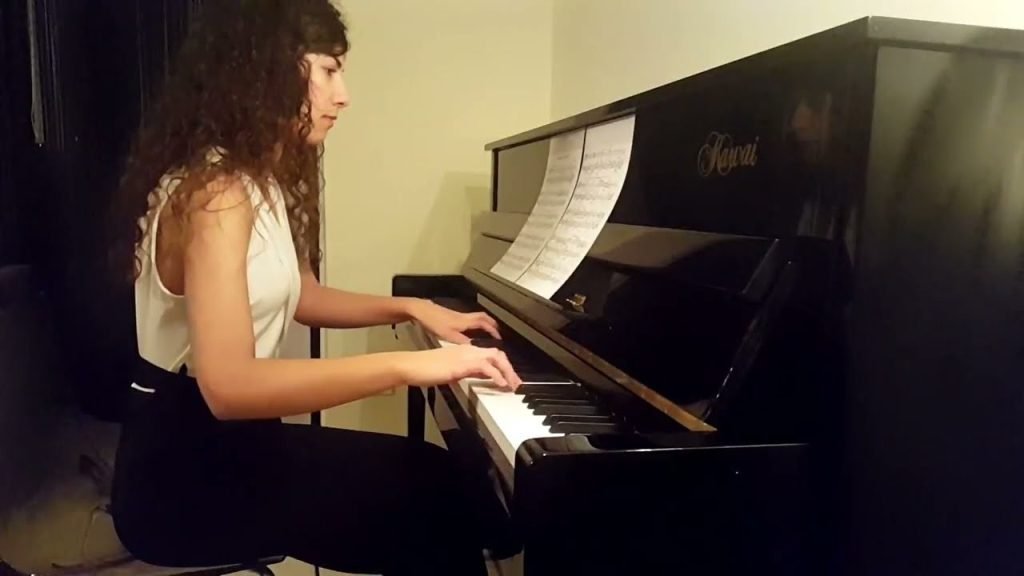
Ariana Abedini plays Mendelssohn’s Venetianisches Gondellied, Op. 30 No. 6. As The Musical Times reminded readers, this is one of the few Songs without Words the composer himself titled “Venetianisches Gondellied.” The rocking compound pulse is gently swayed rather than beaten; the opening stays soft, and the broader crest near the close (2:07) blooms without forcing. On the Kawai upright her left hand keeps the boat’s motion steady while the right sings the cantabile line with unforced warmth: a song without words, truly sung.
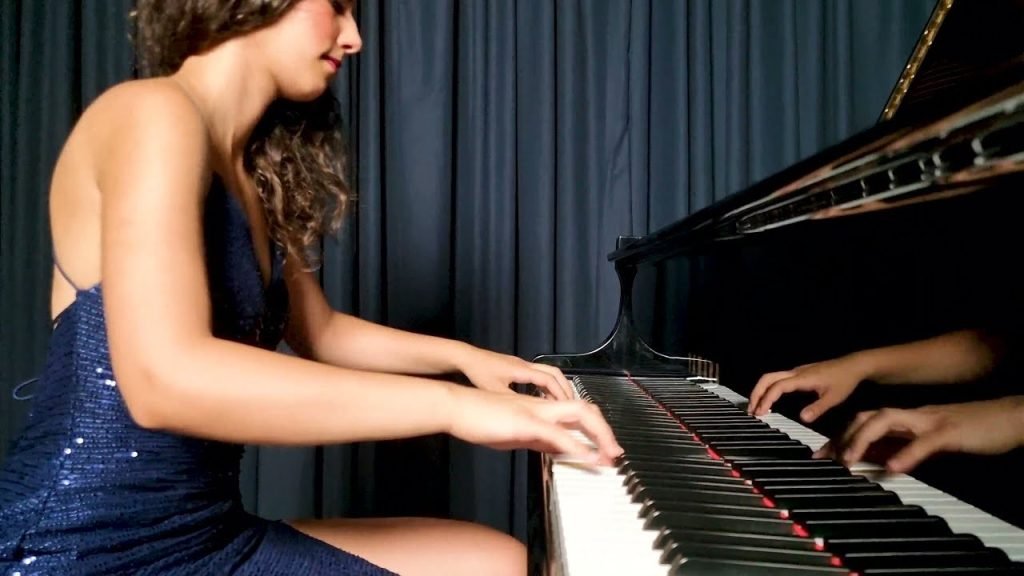
Ariana’s Etude Op. 72 No. 2 in G minor opens already at full voltage, the right hand’s relentless figuration riding a firm left-hand pulse. The Musical Times once called a Moszkowski study “brilliant and showy in the good sense of the term,” and that spirit fits this page. Midway (0:58) the texture grows even busier in the treble, yet her tone stays clear rather than harsh, the Yamaha’s open lid catching every sparkle of the G-minor runs. It is virtuosity worn lightly, poised and sparkling.