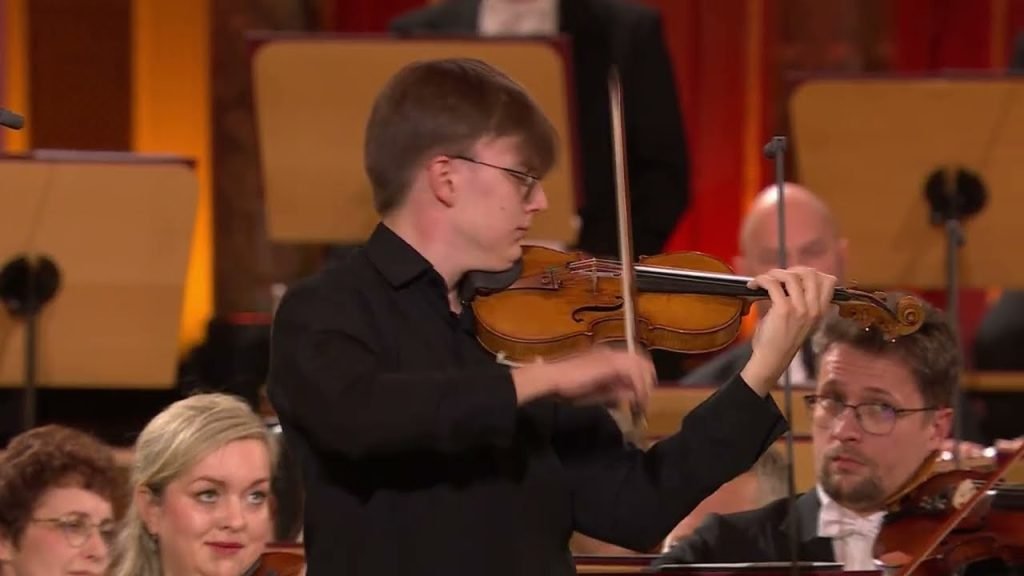
When Pablo de Sarasate introduced Henryk Wieniawski’s Second Violin Concerto—premiered by the composer under Anton Rubinstein in St Petersburg in November 1862 and dedicated to Sarasate—to London’s Philharmonic Society in 1883, The Musical Times sniffed that “a piece written by one virtuoso for another is not generally of great musical value, and Wieniawski’s D minor Concerto is no exception to the rule.” At the 17th International Henryk Wieniawski Violin Competition in Poznań on 22 October 2026, 21-year-old Ukrainian violinist Bohdan Luts clinched First Prize by dismantling that prejudice from within. Where second- and third-prize winners Jinzhu Li and SooBeen Lee reached for the pyrotechnic First Concerto in F-sharp minor, Luts chose Op. 22 and treated it as an aristocratic lyric drama rather than a competition stunt.
Standing beneath the crystal chandeliers of Poznań’s Aula UAM, playing a dark-amber 1740 Carlo Antonio Testore with a c. 1925 Eugène Sartory bow, Luts displays an unshowy physical economy, his gaze fixed on the bow-string contact point. Unlike Jascha Heifetz and Izler Solomon on their 1954 RCA benchmark—which slices through the opening and closing tuttis—Łukasz Borowicz and the Poznań Philharmonic restore the full orchestral exposition before Luts enters (2:14) with a dusky, chest-voiced singing tone on the lowest string. James Huneker wrote in Unicorns (1917) that Wieniawski’s tone “at times was like molten metal. He had a caressing and martial bow.” Luts favours the caress over the sabre: after surging through double-stopped octaves to an imperious peak, he fines his sound down to a whispered pianissimo and shapes the F-major second theme with what The Musical World (10 March 1860) called “marvellous suavity, without allowing it to lose aught of its penetrating quality.”
After the solo clarinet’s seamless bridge, the B-flat major Romance: Andante non troppo (12:09) becomes the performance’s emotional heart. Where Bomsori Kim’s 2018 Warner recording presses the pulse and Michael Rabin’s classic Philharmonia account pours on opulent vibrato, Luts spins a luminous bel canto line, dropping to an intimate thread of sound that holds the hall breathless before cresting nobly. The unaccompanied cadenza launches an infectious Allegro moderato (à la Zingara) of springy, off-the-string bowing and crisp left-hand articulation. Recalling Wieniawski’s own playing in Violin Mastery (1919), Maud Powell observed that “Wieniawski had such a wonderful staccato that one finds much of it in his music.” Luts’s flying staccato and high harmonics in the finale (23:41) flash cleanly, even if his patrician poise occasionally rounds off the last ounce of Gypsy swagger that Heifetz and Maxim Vengerov bring to the coda. Closely but warmly balanced by the Wieniawski Society’s cameras and microphones, this is competition playing of rare poetic stature.