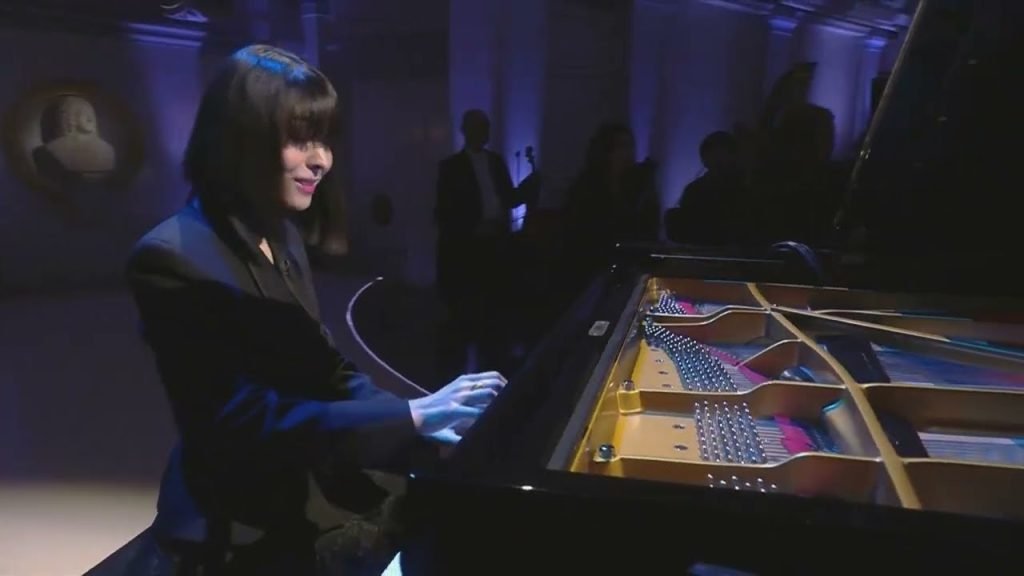
The nocturne has always been credited to Chopin, but the genre was invented by the Irishman John Field, and he did not let the credit go quietly. Field dismissed his famous successor as “a talent of the sick chamber”. Schumann, writing as his gentle alter ego Eusebius, saw a debt rather than a rivalry: Chopin had learnt from Beethoven, Schubert and Field, with Field giving him “his facile hand”. Alice Sara Ott’s recent recording of the complete nocturnes is an act of restoration, and this gala performance shows why the originals deserve better than footnote status.
The left hand starts at once, a gently rocking accompaniment, and the melody enters almost immediately with a warm, singing tone that is never pushed. Ott’s tempo is spacious, and her rubato is generous but stylish, stretching phrase-ends and the approach to melodic leaps without ever stopping the music’s flow. The contrasting section from about 0:54 searches more widely. Its rapid fioriture, Field’s ornamental runs and the busiest playing of the performance, are played with a liquid, pearly touch, as ornaments that sing rather than show off. The emotional peak comes around 1:40, the loudest music in the piece, and she eases the tempo back markedly around it so that the return of the theme arrives as a quiet release rather than a reset.
Writing in The Art of Music, Leland Hall described Field’s nocturnes as “an emanation of mood or sentiment, not a presentation of them”. It is a backhanded compliment, but it captures what Ott understands. She does not try to make this music more dramatic than it is. The lush pedalling keeps the harmonies glowing and changes cleanly, the balance is impeccable, and I heard no slips. If anything, the performance is so smooth and controlled that a little more vulnerability in the return would not go amiss. The final chord (about 3:02) is allowed to ring before the applause breaks in.
The broadcast sound is excellent: direct, warm, with a natural bloom from the hall and no distortion. The gala staging, with deep blue and purple lighting, chandeliers, and an idle orchestra in the background, is atmospheric, though the director’s repeated superimpositions of hands over wide shots of the hall verge on music-video cliché.