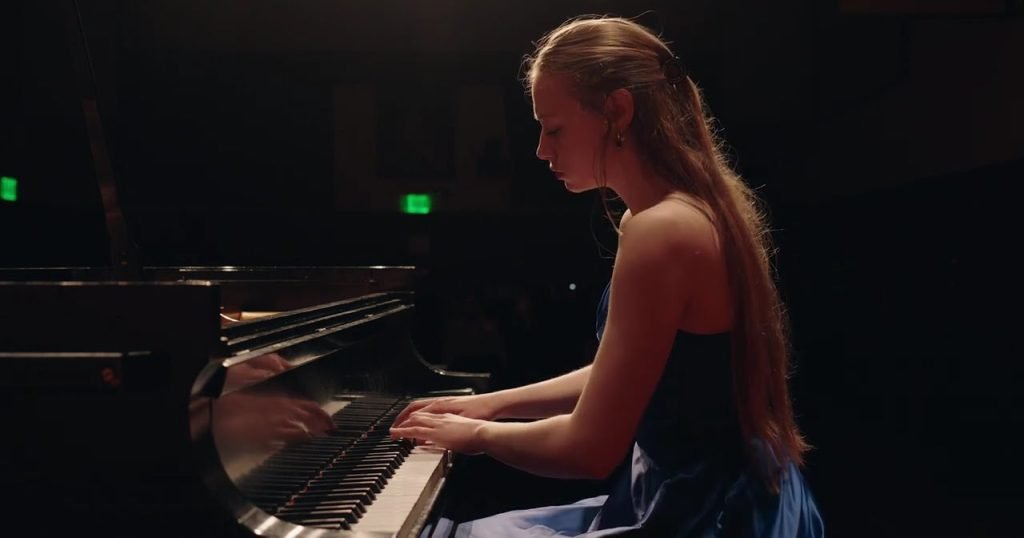
Alexandra Burch is a talent to be experienced rather than merely heard, and her account of Scarlatti’s Sonata in B minor, K. 87, makes that plain within its opening bars. This is an inward, singing sonata in which several voices move together and gently overlap, and she plays it with the calm assurance of a pianist who trusts the music to speak for itself.
Her touch is what captivates first. Her beautiful, delicate fingers seem to dance across the keys rather than press them, so that every line sings with a soft, rounded glow. On the opening page, where Scarlatti holds notes over the bar line so that one voice leans tenderly against the next, she lets each of those small tensions ache and then melt, never hurrying the release. The pulse stays unhurried and even, yet nothing sounds mechanical; she eases into the first phrase as naturally as a singer drawing breath.
J. A. Fuller Maitland, in The Oxford History of Music (1902), wrote of “the quaintly artificial melancholy of a few” of these sonatas. There is nothing artificial about her melancholy. When the first half comes to rest on its hushed, open-ended chord, she lingers just long enough for the silence to carry meaning, and the second half (1:12) begins as if continuing a thought rather than starting anew.
Charles Burney reported Scarlatti’s own reasoning: “as Nature had given him [Scarlatti] ten fingers, and, as his instrument had employment for them all, he saw no reason why he should not use them.” Alexandra Burch gives all ten their employment with remarkable grace. In the second half, as the flowing runs in the upper voice grow fuller, she lets the sound bloom warmly, reaching its richest glow around (1:57), and then draws it back with exquisite care, so that the closing pages fade softly towards the final deep bass note, a true and quiet farewell. The inner voices stay clear throughout, and the left hand supports the melody like a gentle hand on the shoulder.
The film adds to the pleasure: the warm, wood-panelled setting suits the music’s intimacy, and in the final pages the camera moves to the side of the keyboard, letting us watch her hands shape the last phrases with quiet poise.
The 1915 survey The Art of Music observed that “Many of Scarlatti’s short pieces have the warmth of genuine emotion,” and this performance makes that warmth felt in every bar. It is musical, sincere and beautifully poised. I will follow her posts closely.