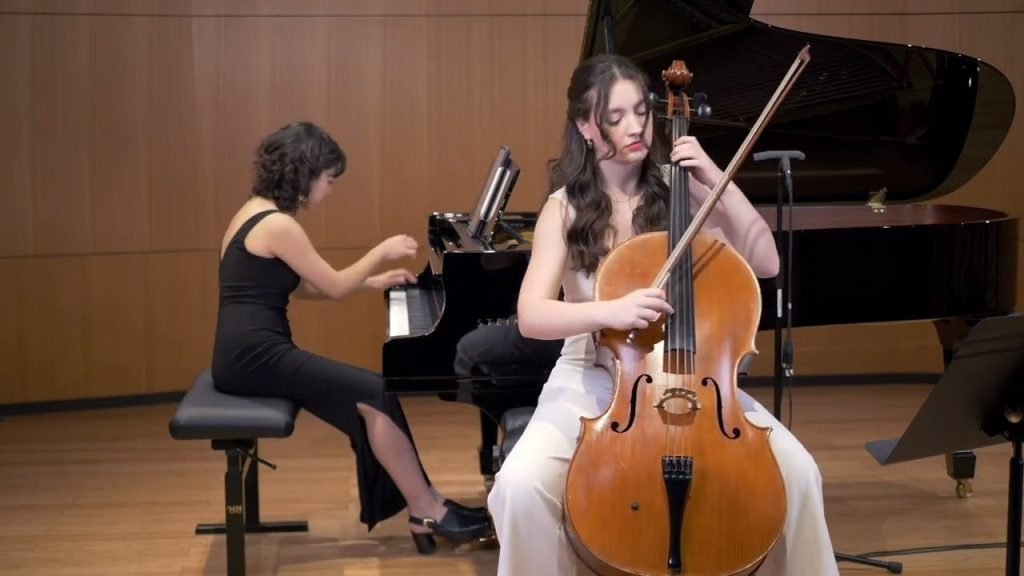
This is one of my favourite cello sonatas, and I was glad to find Lydia Rhea and Amber Scherer’s recording of it, made in November 2024.
Debussy wrote it in the summer of 1915 and dedicated it to Emma Debussy, as the first of a planned set of “Six sonates pour divers instruments”. Its London premiere, given by Warwick Evans and Mrs Alfred Hobday at the Aeolian Hall in March 1916, drew a cool notice in The Musical Times: “It did not prove especially interesting, although it was finely played.” In 1917 the same journal was more patient: “Audiences no less than performers will have to study hard and long ere this work yields up its secrets, but illumination will surely come soon.” In May 1918 it described “the charming little affectation of the title-pages”, with their “imitation of the type of the old French title-pages”. The illumination did come. Writing for Bachtrack in 2024, Phil Parker called the sonata “the closest the recital came to mainstream programming”.
The Prologue, marked “Lent, sostenuto e molto risoluto”, begins with Scherer alone at the Steinway while Rhea waits with her bow lowered. That matches what Frances Wilson heard at a Proms chamber concert in 2012, also for Bachtrack: “The sonata opens with a noble statement in the piano”. At the other end of the movement, the sound thins away into true silence (4:39) before the Sérénade begins.
In the Sérénade, Rhea plucks the opening while still holding the bow in her right hand, and the movement turns out to be the most densely articulated of the three. Susannah Moody, reviewing Anastasia Kobekina at Wigmore Hall, heard “a more playful cat-and-mouse dance in the Serenade”, and Rhea’s repeated switches between plucked and bowed sound here point the same way. Then the pair run the Sérénade straight into the Finale with no silence at all, the opposite of the hush that closed the Prologue.
The Finale, “Animé, léger et nerveux”, opens with Rhea plucking again (7:58) before she takes up the bow. Its central episode is quieter and sparser than the music on either side of it, and its closing pages hold the loudest instant of the whole performance.
Eduard Hanslick, in Gustav Cohen’s 1891 translation of The Beautiful in Music, asked his readers to “Imagine now an arabesque, not still and motionless, but rising before our eyes in constantly changing forms.” This sonata, with its turns between plucked and bowed sound and between silence and its loudest pages, seems to me a fine answer to that image. I am grateful to hear it again in these hands.