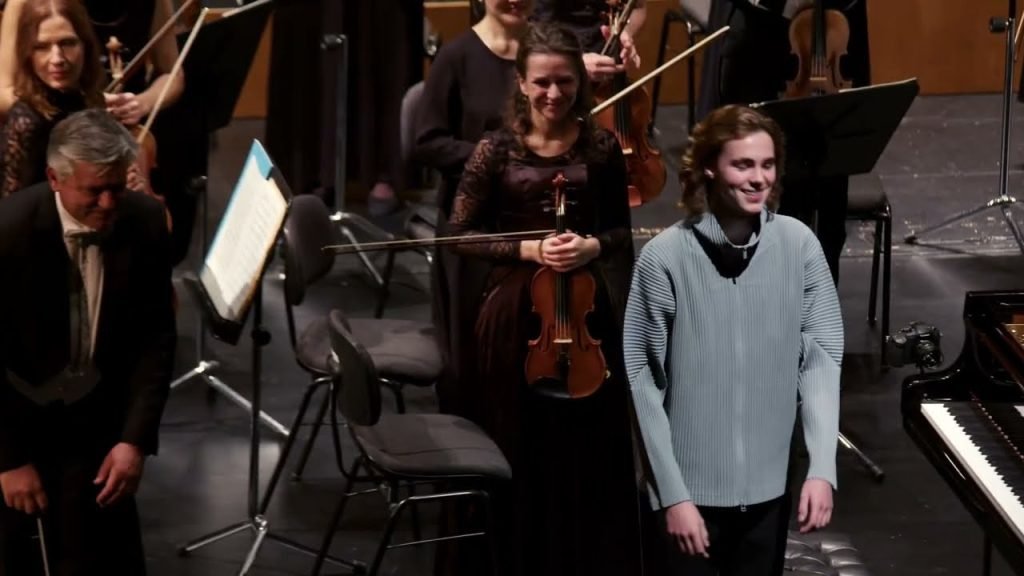
There is a quiet historical symmetry to hearing Beethoven’s Emperor Concerto at the Anhaltisches Theater in Dessau. When the twenty-five-year-old Friedrich Schneider gave the world premiere of Op. 73 at the Leipzig Gewandhaus on 28 November 1811, the Allgemeine musikalische Zeitung (January 1812) hailed it as “without doubt one of the most original, imaginative, most effective, but also one of the most difficult of all existing concertos.” A decade later, in 1821, Schneider became Hofkapellmeister in Dessau, spending thirty-two years shaping the Ducal Court Orchestra that evolved into today’s Anhaltische Philharmonie Dessau. Stepping onto Schneider’s ancestral stage beneath its amber-lit wooden acoustic shell, seventeen-year-old Justus Eichhorn strips five generations of imperial varnish from the score.
Composed amid Napoleon’s 1809 bombardment of Vienna, when Beethoven wrote to Breitkopf & Härtel (26 July 1809) of “nothing but drums, cannons, human misery of every sort,” Op. 73 often tempts soloists into martial grandiloquence. Where Krystian Zimerman and Leonard Bernstein stretch the work to granite breadth, Eichhorn and Frank keep it lithe—closer to Leif Ove Andsnes’s chamber-scaled urgency or Murray Perahia’s aristocratic poise. From the first fortissimo E-flat orchestral chord and Eichhorn’s opening cadenza (0:38), the teenager favors quicksilver finger-weight over percussive mass. In the third introductory flourish, he tapers his tone to a hushed whisper before handing the Allegro exposition to Frank’s crisp beat. Even in the first movement’s B-minor second theme and the fierce octave confrontation of the development, Eichhorn keeps his wrists low and the texture aerated, honouring Beethoven’s autograph instruction at the recapitulation (“non si fa una cadenza, ma s’attacca subito il seguente”) with an unforced transition into the dolce horn duet.
That refusal to linger shapes the B-major Adagio un poco mosso. Entering (21:46) over warm muted strings, Eichhorn treats the movement not as a static monument but as an inward, vocal nocturne whose trills shimmer without sentimental drag. When the horns and bassoons drop a semitone from B-natural to B-flat, Eichhorn breathes the Rondo’s motif in two ghostly waves before erupting straight into it (27:59). If the Dessau strings occasionally sound lean beside Vienna or Amsterdam in the tutti refrains, the finale’s closing duet with the timpani and exuberant final scale, captured with a natural hall dynamic range by Daniel Gronsfeld, confirm why Deutsche Grammophon signed Eichhorn so young.